





In this article
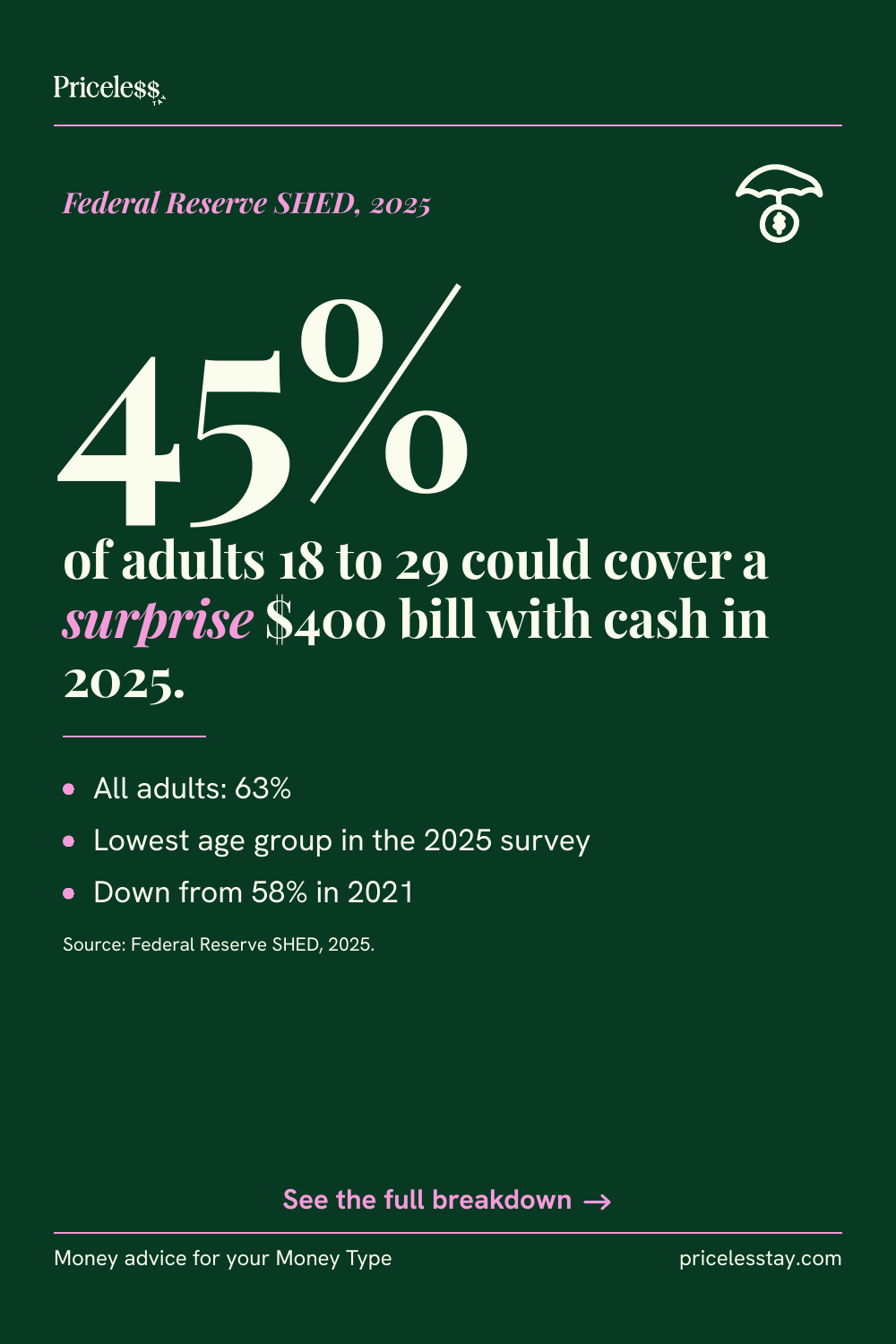
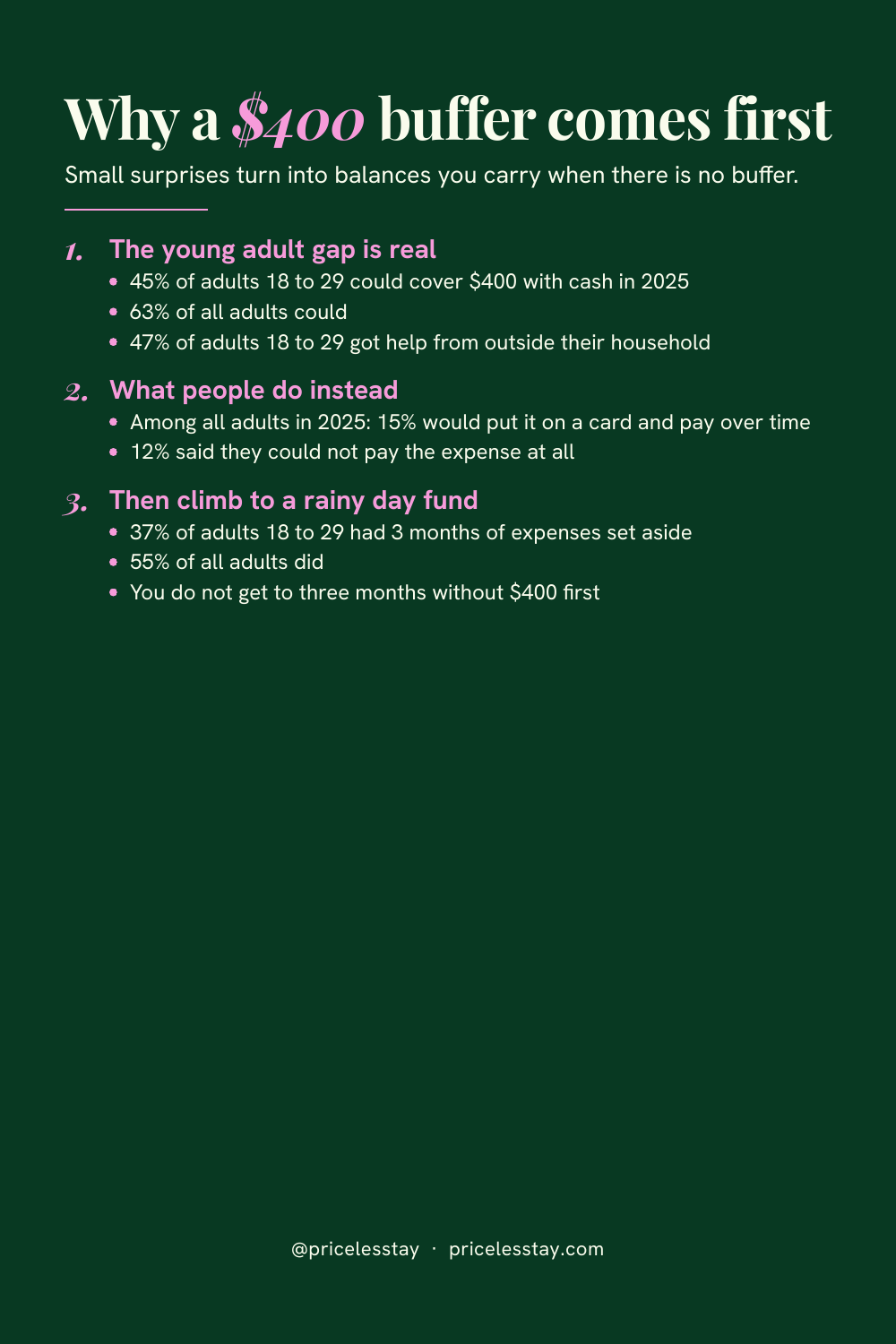
In 2025, 45% of adults ages 18 to 29 would cover a $400 emergency with cash or its equivalent, per the Fed. See the chart and your first fix.
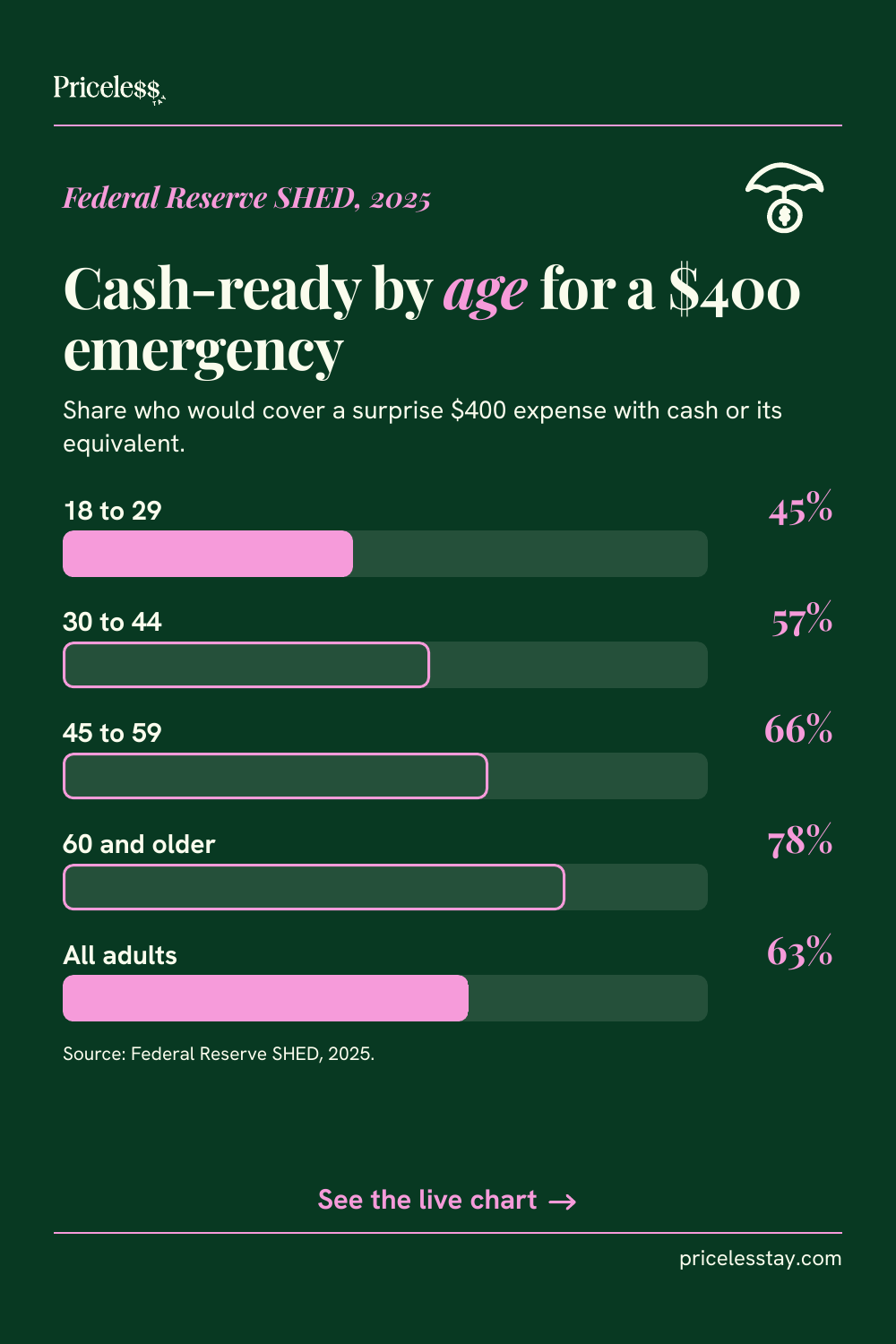
If a surprise $400 bill would wreck your month, you have a lot of company, and the fix is smaller than it feels: one $400 buffer you build before anything else. In 2025, only 45% of adults ages 18 to 29 said they would cover a $400 emergency expense with cash or its equivalent, according to the Federal Reserve's SHED data (2025 survey, published May 2026). That means more than half of young adults would borrow, sell something, carry a credit card balance, or not be able to pay it at all.
Money Type lens: This one is for Scramblers first. When payday has no set order, every surprise feels like an emergency, and the buffer transfer is the one that keeps getting skipped. The payday order in the Money Type section below (bills due this week, then the buffer, then everything else) is the part to copy. The first fix: Bills First. Spenders lose the $400 another way, since money in checking looks available, so keeping the buffer in an account with no debit card matters most for them. Find out which one sounds like you with the Money Types quiz.
Key takeaways
- 45% of adults ages 18 to 29 would cover a $400 emergency with cash or its equivalent in 2025, compared with 63% of all adults (Federal Reserve SHED, 2025).
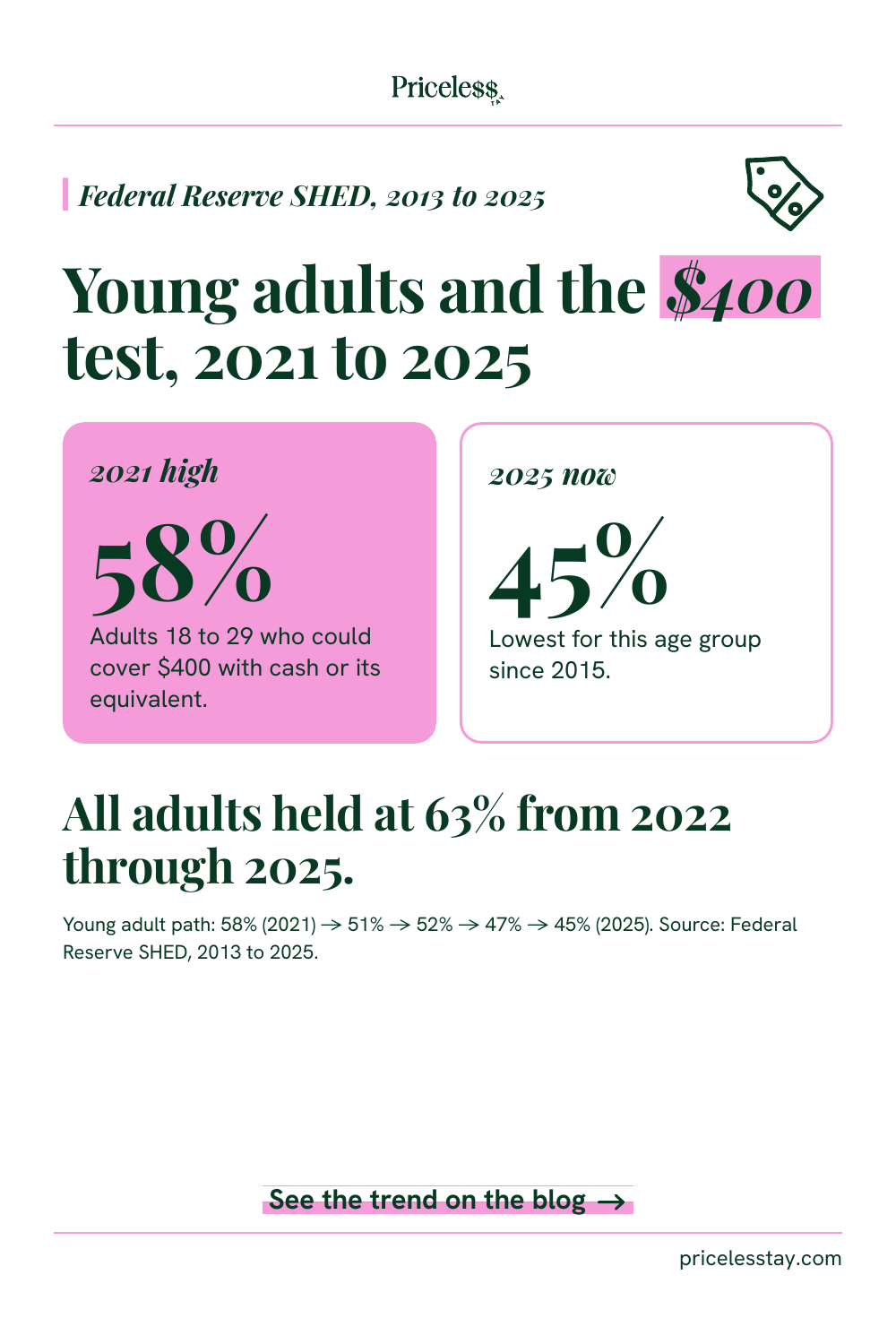
- The young adult share dropped from 58% in 2021 to 45% in 2025, the lowest for this age group since 2015 (Federal Reserve SHED, 2013 to 2025).
- The first fix is one separate $400 buffer. How you build it depends on your Money Type.
How many young adults can cover a $400 emergency expense?
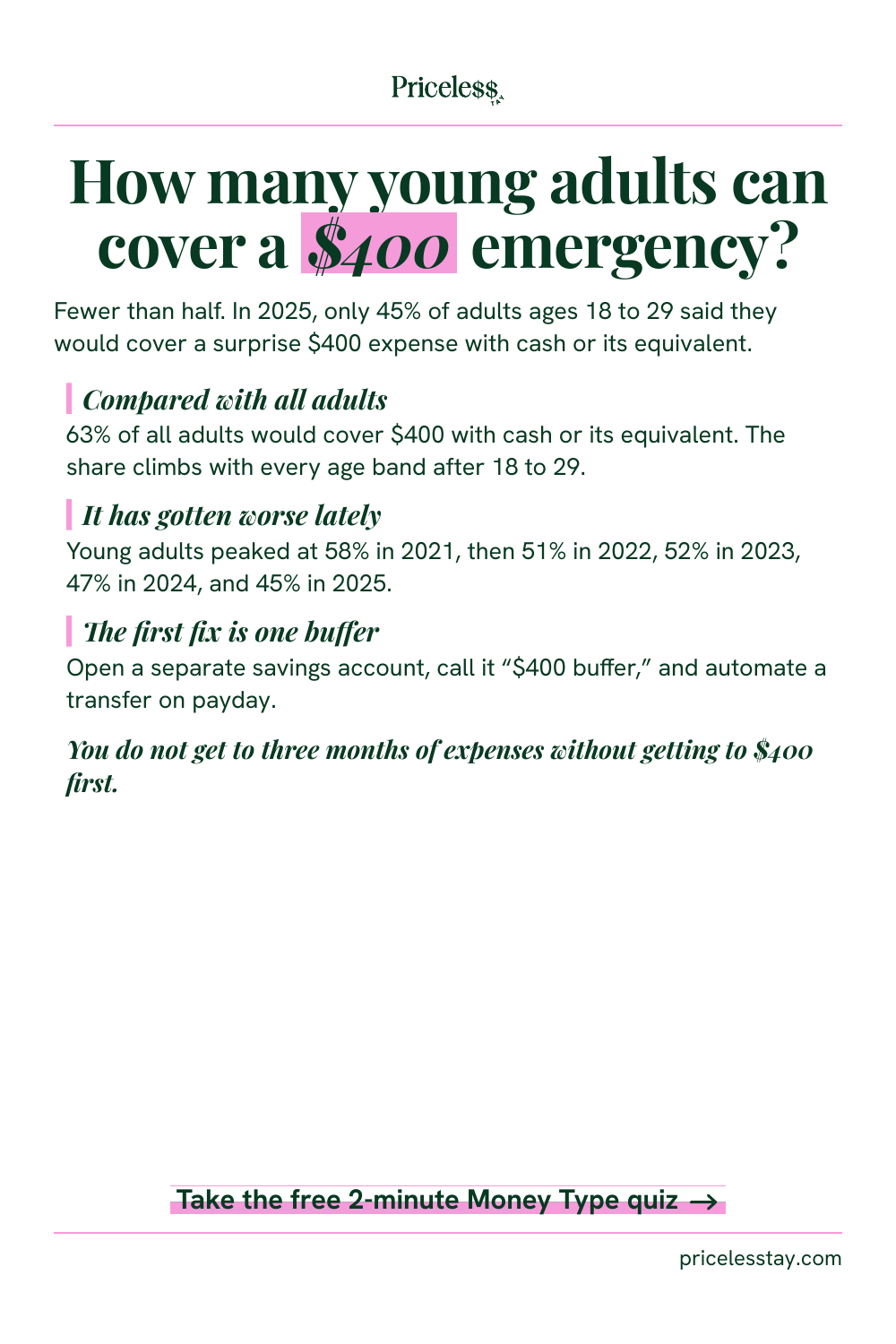
Fewer than half. The Fed's Survey of Household Economics and Decisionmaking (SHED) asks adults how they would pay for a surprise $400 expense. In the 2025 survey, the youngest group had the lowest share of any age group, and the share climbs with every age bracket after that.
Money chart
Fewer than half of 18 to 29 year olds could cover a $400 emergency
45% would pay a surprise $400 expense with cash or its equivalent, compared with 63% of all adults.
| Group | Would cover a $400 emergency with cash or its equivalent (2025) |
|---|---|
| 18 to 29 | 45% |
| 30 to 44 | 57% |
| 45 to 59 | 66% |
| 60 and older | 78% |
| All adults | 63% |
Source: Federal Reserve, Economic Well-Being of U.S. Households in 2025 (SHED), 2025 survey, published May 2026. Share or download this chart
| Age group | Would cover a $400 emergency with cash or its equivalent (2025) |
|---|---|
| 18 to 29 | 45% |
| 30 to 44 | 57% |
| 45 to 59 | 66% |
| 60 and older | 78% |
| All adults | 63% |
Source: Federal Reserve, Economic Well-Being of U.S. Households in 2025 (SHED), published May 2026. Age data from the SHED data visualization table. Survey fielded October 2025.
What does "cash or its equivalent" mean?
The Fed counts three ways of paying as "cash or its equivalent": cash, money in savings, or a credit card you pay off in full at the next statement (Federal Reserve SHED, 2025). Everyone else said they would borrow, sell something, or couldn't cover it. Among all adults in 2025, 15% said they would put it on a credit card and pay it off over time, and 12% said they wouldn't be able to pay the expense right now by any means (same report, table 25).
Has it gotten better or worse for young adults?
Worse, lately. The share of 18 to 29 year olds who could cover $400 with cash or its equivalent peaked at 58% in 2021, then landed at 51% in 2022, 52% in 2023, 47% in 2024, and 45% in 2025 (Federal Reserve SHED, 2013 to 2025). Over the same stretch, the number for all adults held at 63% from 2022 through 2025.
Plenty of young adults are also getting help from other people. In the same 2025 survey, 47% of adults ages 18 to 29 said they got help from someone outside their household to pay an expense in the prior 12 months (Federal Reserve SHED, 2025). None of that is a character flaw. It usually means there's no buffer sitting between your paycheck and the rest of your life yet.
Why does a $400 buffer matter so much?
Because $400 is small enough to be an everyday surprise: a car repair, a vet visit, a last-minute flight home. Those don't wait for payday. When there's no buffer, a small surprise turns into borrowing, and whatever you borrow comes out of next month's money too.
It's also the first rung of a bigger ladder. The Fed also asks whether people have a rainy day fund that could cover three months of expenses. In 2025, 37% of adults ages 18 to 29 said yes, compared with 55% of all adults (Federal Reserve SHED, 2025, table 27). You don't get to three months without getting to $400 first, so that's where the system starts.
How do you build your first $400 buffer?
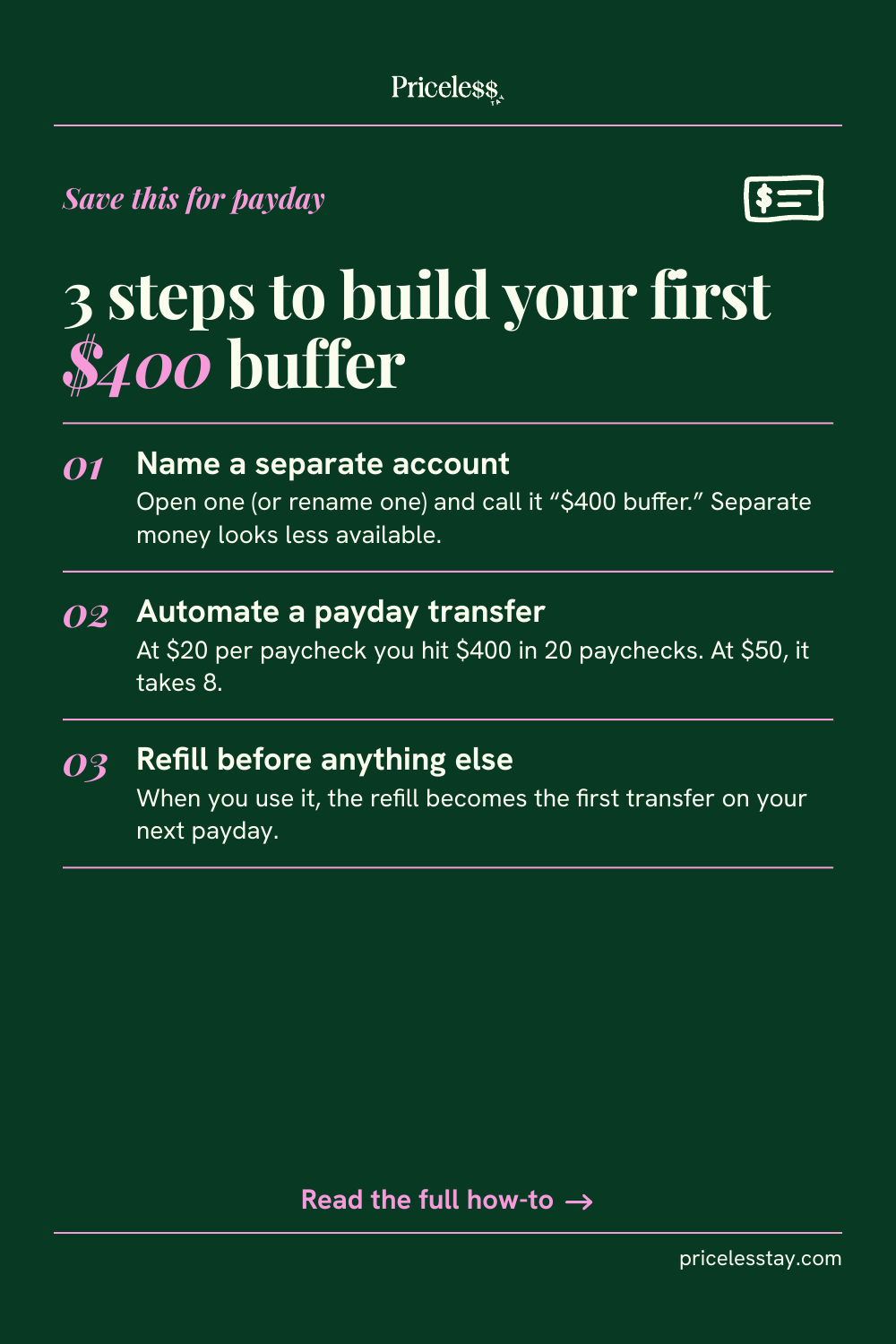
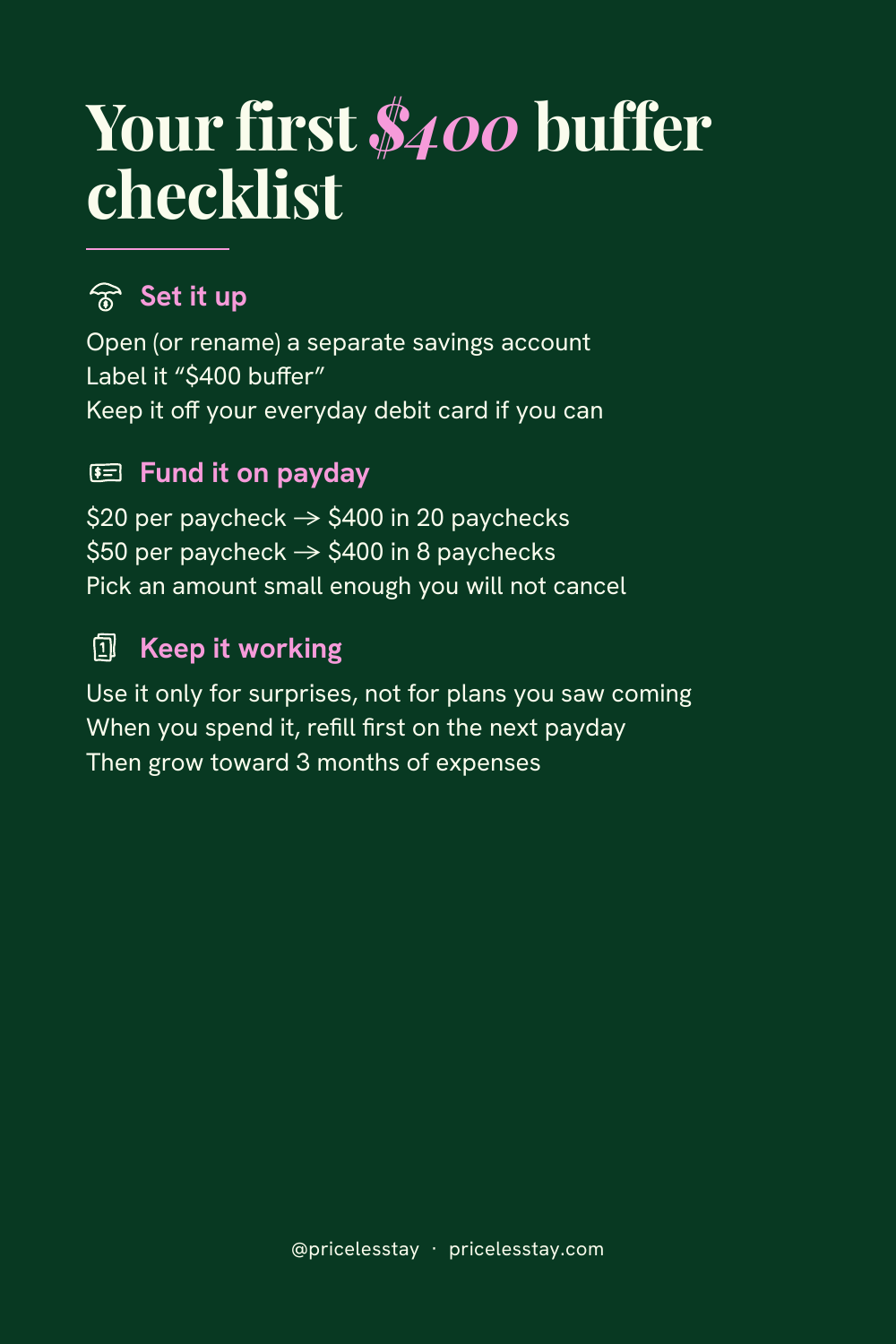
Here's the one action: open a separate savings account (or rename one you already have) and call it "$400 buffer." Then set an automatic transfer that hits it on payday. Separate matters, because money sitting in checking looks available, and money that looks available gets spent.
The math is simpler than it feels. At $20 per paycheck, you hit $400 in 20 paychecks. At $50 per paycheck, it takes 8. Pick an amount small enough that you won't cancel it next week, even if it feels slow at first.
Two rules keep it working. First, the buffer is only for surprises, not for sales or plans you saw coming. Second, when you use it, refilling it becomes the first transfer on your next payday. Once it's full and staying full, use the emergency fund calculator to set your bigger target, and read up on what counts as an emergency fund so the next layer has clear rules too.
How does your Money Type change the first fix?
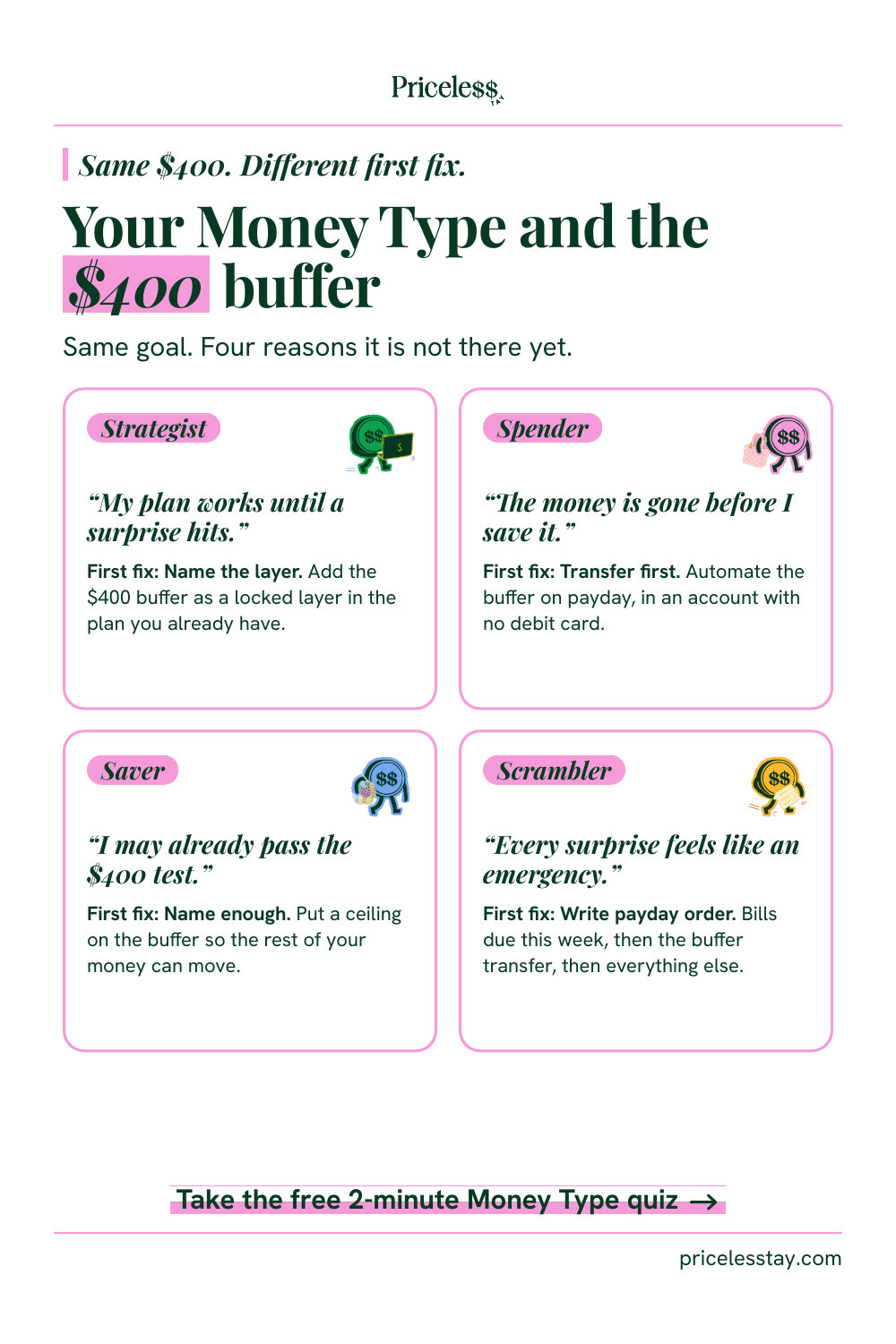
Same $400, different reason it isn't there yet. Priceless Tay's 4 Money Types describe what you actually do when money gets emotional, and each one gets stuck in a different spot.
Strategist (has a working plan that needs to scale). Your money system mostly works, but a surprise still knocks it sideways because the buffer isn't locked in. Your first fix is adding the $400 buffer as a named layer in the plan you already have, so the rest of the system can scale without getting raided by every small emergency.
Spender (spends first, thinks later). The money is gone before saving ever comes up. Your first fix is making the transfer happen on payday before you check your balance, and keeping the buffer in an account with no debit card attached, so it's never one tap away.
Saver (saves but money never moves). You may already pass the $400 test with room to spare. Your first fix is putting a number on "enough," so the buffer and your full emergency fund have a clear ceiling and the rest of your money has permission to work on other goals. For investing decisions, talk to a licensed professional.
Scrambler (lives in crisis mode). Every surprise feels like an emergency because there's no order to payday yet. Your first fix is writing your payday order down: bills due this week, then the buffer transfer, then everything else. When the buffer gets used, the refill moves to the top of the list.
How does a $400 buffer help you retire rich?
Retire rich means your money system supports the life you actually want while your money grows in the background. A buffer is the least glamorous part of that system and one of the most protective. When a surprise doesn't turn into a balance you carry, next month's money stays pointed at your goals instead of last month's emergency.
The order is simple: your Money Type points to your first fix, the first fix builds the $400 buffer, and the buffer grows into a full emergency fund that keeps the long-term part of your money system from getting raided.
Not sure which first fix is yours? Take the free Money Types quiz to find your type and the first step that fits how you actually handle money.
FAQ
What percentage of Americans can cover a $400 emergency?
In 2025, 63% of all U.S. adults said they would cover a $400 emergency expense with cash or its equivalent (Federal Reserve SHED, 2025). That share was unchanged from the previous three years and down from a high of 68% in 2021.
How many Gen Z adults can cover a $400 expense?
The Fed reports by age, not by generation. Among adults ages 18 to 29, 45% said they would cover a $400 emergency with cash or its equivalent in 2025, the lowest of any age group (Federal Reserve SHED, 2025).
How much emergency savings should a young adult have?
Start with a $400 buffer, then build toward three months of expenses, the rainy day fund benchmark the Fed's survey uses. In 2025, 37% of adults ages 18 to 29 said they had that much set aside (Federal Reserve SHED, 2025).
Is it bad to put a $400 emergency on a credit card?
If you pay it off in full at the next statement, the Fed counts that as cash or its equivalent. Carrying a balance means paying interest, which is why a cash buffer is the cheaper backup. For decisions about debt you already have, talk to a licensed professional.
You made it to the end. That's Saver-level patience.