
In this article
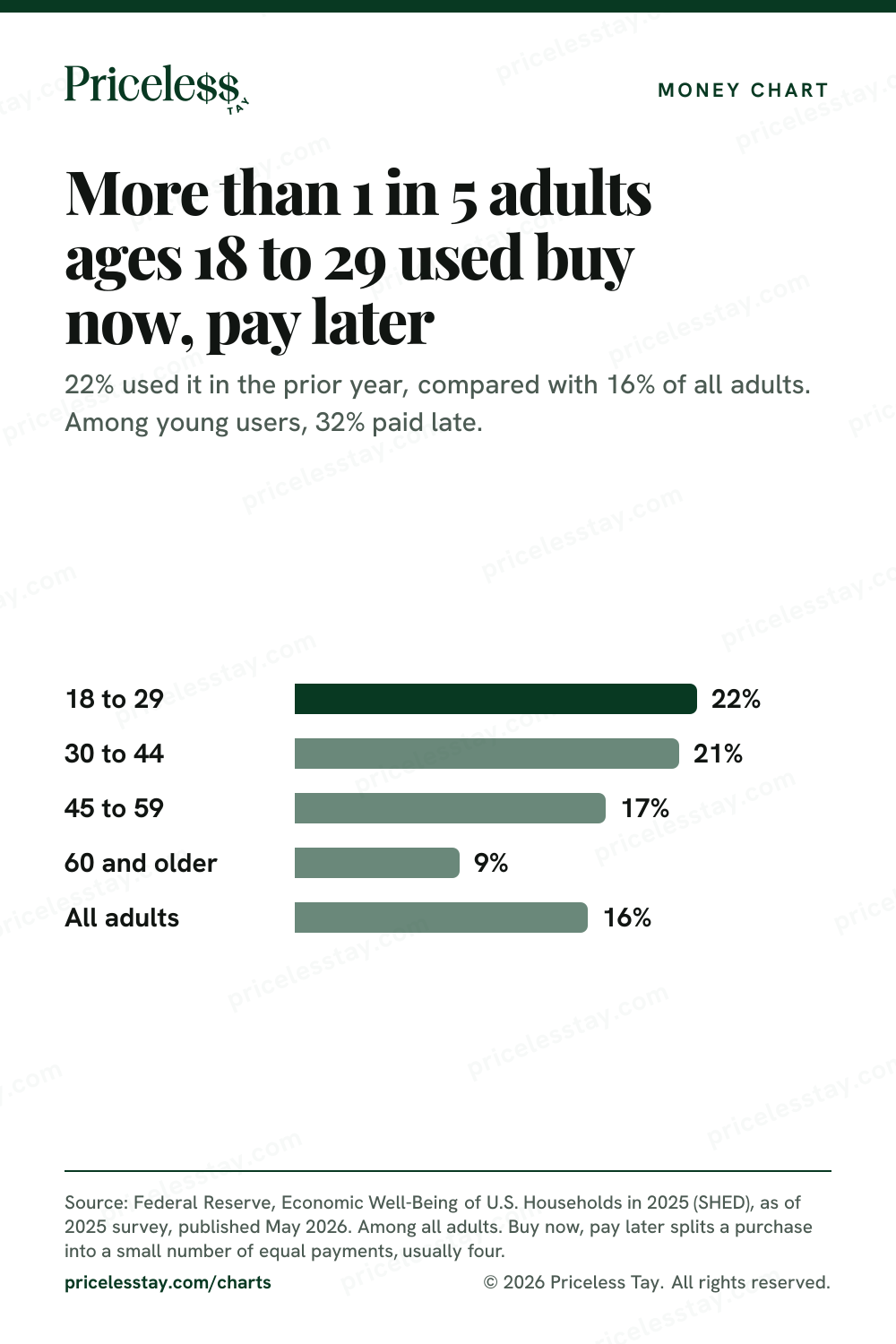
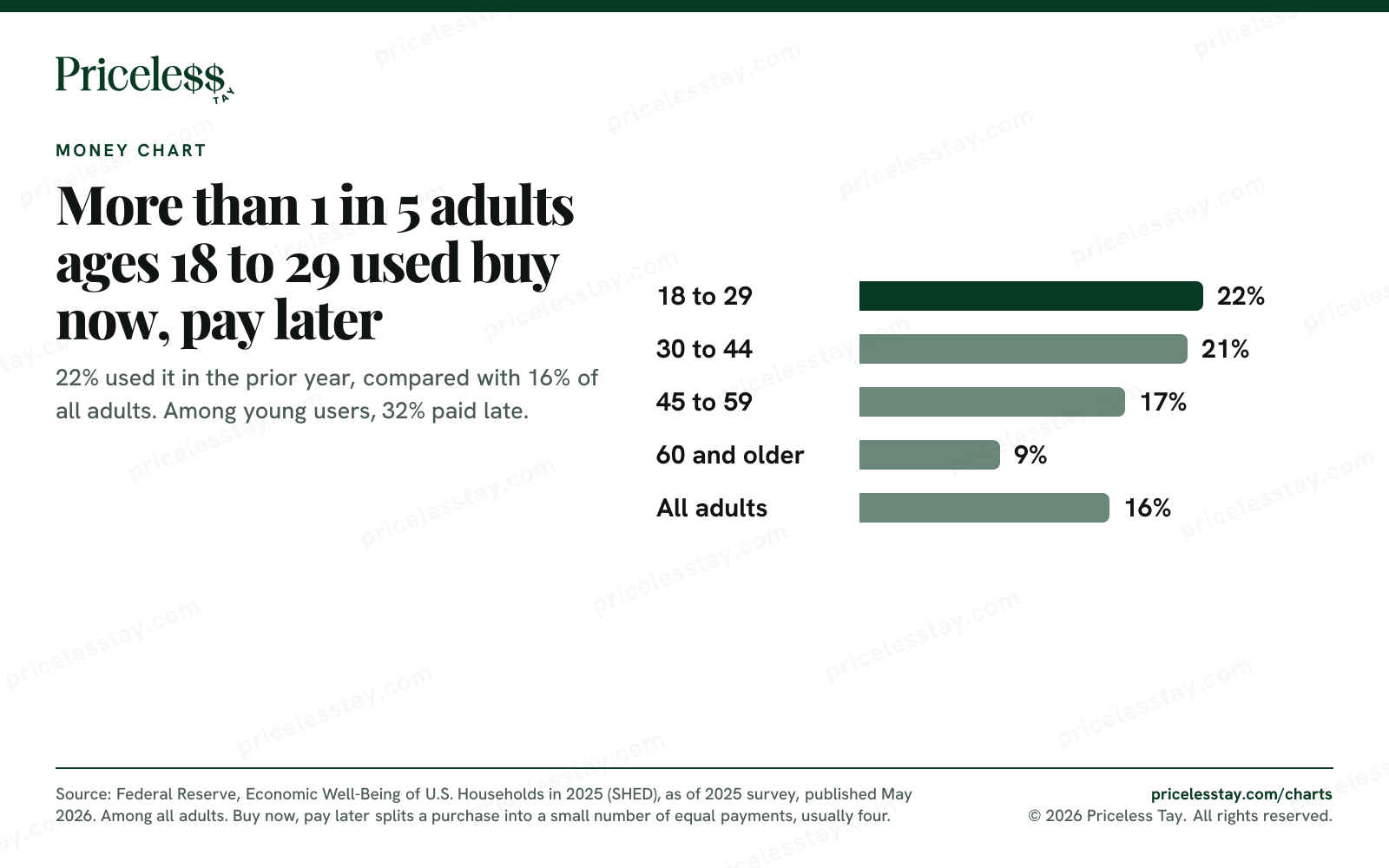
22% used it in the prior year, compared with 16% of all adults. Among young users, 32% paid late.
Explore the data
| Group | Used buy now, pay later in the prior 12 months (2025) |
|---|---|
| 18 to 29 | 22% |
| 30 to 44 | 21% |
| 45 to 59 | 17% |
| 60 and older | 9% |
| All adults | 16% |
Source: Federal Reserve, Economic Well-Being of U.S. Households in 2025 (SHED), as of 2025 survey, published May 2026.
How many young adults use buy now, pay later?
About 1 in 5. In the Federal Reserve's 2025 Survey of Household Economics and Decisionmaking (SHED), 22% of adults ages 18 to 29 said they used buy now, pay later (BNPL) in the prior 12 months. Adults ages 30 to 44 were close behind at 21%, then use drops to 17% for ages 45 to 59 and 9% for ages 60 and older. Among all adults, it was 16%.
How often do young users pay late?
Among 18 to 29 year olds who used BNPL, 32% paid late, compared with 31% for ages 30 to 44, 22% for ages 45 to 59 and 12% for ages 60 and older. Across all users, 26% paid late, and 64% of those who paid late said they were charged extra. Because most BNPL plans pull payments from a checking account on autopay, 11% of all users had a BNPL payment trigger an overdraft or non-sufficient funds fee.
Has buy now, pay later use grown?
Yes. Among all adults, BNPL use went from 10% in 2021 to 12% in 2022, 14% in 2023, 15% in 2024 and 16% in 2025. Over the same years, the share of users who paid late went from 15% to 26%.
Where does this data come from?
From the credit chapter of the Federal Reserve's report, Economic Well-Being of U.S. Households in 2025 (table 41 and figure 33), published May 2026. The 2025 survey was fielded in October 2025. The Fed reports by age group, not by generation.
What this means for you
Save in four before you buy, instead of paying in four after.
Splitting a purchase feels free until a payment lands on a low week. Saving the same four payments first means you buy it a little later, with no late fee and no autopay hitting a thin checking account. How you stick with it depends on your Money Type: Strategist, Spender, Saver or Scrambler. The free quiz shows which first fix fits you.
Questions
In 2025, 22% of adults ages 18 to 29 said they used buy now, pay later in the prior 12 months, the highest of any age group, according to the Federal Reserve's SHED survey. The Fed reports by age, not by generation.
16% of all U.S. adults used buy now, pay later in the prior 12 months in 2025, up from 10% in 2021, when the Fed first asked about it.
26% of all users paid late in 2025. Among users ages 18 to 29, it was 32%. Of users who paid late, 64% said they were charged extra.
Yes. Download the images or copy the embed code on this page. Please keep the source line and link back to this page.
Source and methods
Data from Federal Reserve, Economic Well-Being of U.S. Households in 2025 (SHED), as of 2025 survey, published May 2026. Among all adults. Buy now, pay later splits a purchase into a small number of equal payments, usually four. Chart and analysis by Priceless Tay. Rules can change after this date, so check your state's department of education for the latest.
You made it to the end. That's Saver-level patience.